
Getting into cryptocurrency for the first time raises a lot of questions. One of the most common ones is also one of the most fundamental: how does a crypto wallet actually work? If you have been wondering the same thing, this guide is written specifically for you.
By the end of this article you will have a clear, jargon-free understanding of how crypto wallets function, what happens when you send or receive cryptocurrency, and what you need to know before getting started.
Starting With the Basics
Before understanding how a crypto wallet works, it helps to understand what cryptocurrency actually is at a basic level.
Cryptocurrency is a form of digital money that exists on a blockchain — a decentralised public record of every transaction ever made with a particular cryptocurrency. It is maintained simultaneously across thousands of computers around the world, which means no single person or company controls it.
When you own cryptocurrency, what you actually own is a record on that blockchain that says a certain amount of digital assets belongs to the address associated with your wallet. The crypto wallet is the tool you use to access, manage, and move those assets.
What a Crypto Wallet Actually Does
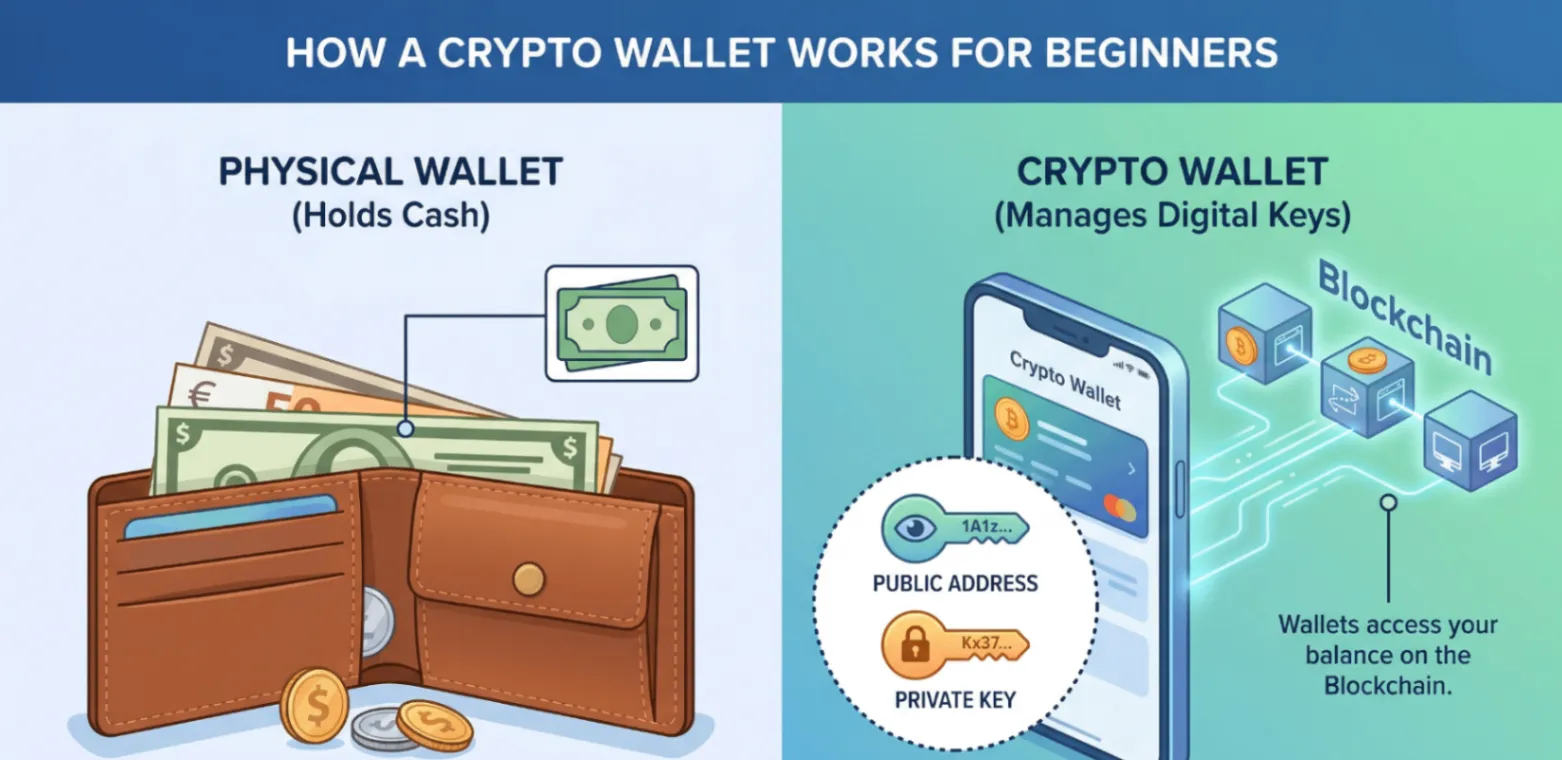
Here is the key thing that surprises most beginners: a crypto wallet does not actually store your cryptocurrency. Your digital assets live on the blockchain at all times. What your wallet stores are the cryptographic keys that prove your ownership and allow you to authorise transactions.
Think of the blockchain as a giant public safe deposit facility. The boxes in that facility belong to whoever has the right key. Your crypto wallet holds your keys. Without them, you cannot access your assets.
Your public key is like your bank account number or your email address. You can share it freely with anyone who wants to send you cryptocurrency — it is safe to share because knowing your public key alone does not give anyone access to your funds.
Your private key is like your password or PIN. It is what you use to authorise transactions and prove to the blockchain that you are the legitimate owner of those funds. Your private key must never be shared with anyone. Whoever holds the private key has complete and irreversible control over the associated cryptocurrency.
How Sending and Receiving Crypto Works
When someone sends you cryptocurrency, they broadcast a transaction to the blockchain network that assigns a certain amount of digital assets to your public address. Your wallet reads the blockchain and updates your displayed balance to reflect the incoming funds. This typically happens within seconds to a few minutes depending on the network.
When you want to send cryptocurrency to someone else, you open your wallet, enter the recipient's public address, and specify the amount you want to send. Your wallet then uses your private key to digitally sign the transaction — a form of cryptographic proof that you are the authorised owner. The signed transaction is broadcast to the network, validated by multiple computers, and permanently recorded on the blockchain.
Once a transaction is confirmed on the blockchain it cannot be reversed. This is one of the most important things for every crypto beginner to understand. Always double-check wallet addresses before confirming a send.
Understanding Your Seed Phrase
When you set up a crypto wallet for the first time, the wallet generates a seed phrase — a sequence of 12 to 24 randomly selected words. This seed phrase is the master backup of your entire wallet. All your private keys can be recovered from it.
Write your seed phrase down by hand on paper the moment you receive it. Store that paper somewhere safe, secure, and completely offline. Never take a photograph of it, never store it in a notes app or cloud service, and never share it with any person or service for any reason whatsoever.
If you lose access to your device, your seed phrase is the only thing that can restore your wallet and your funds. Losing both your device and your seed phrase means permanently losing your cryptocurrency with no way to recover it.
Custodial vs Non-Custodial Wallets for Beginners
As a beginner you will encounter two main types of crypto wallets, and understanding the difference is essential.
A custodial wallet is one where a company such as a crypto exchange holds your private keys on your behalf. Your funds are accessible through their platform but you are trusting that organisation to keep your assets safe. If the platform is hacked, becomes insolvent, or freezes withdrawals, your funds may be inaccessible or lost.
A non-custodial wallet is one where you hold your own private keys. No company or third party has access to your funds. This is widely considered the safer and more responsible approach to holding cryptocurrency. KIML Wallet is a non-custodial crypto wallet, meaning your keys stay with you at all times and no one else can access your assets.
For beginners who want to genuinely own their cryptocurrency rather than simply having a balance on an exchange, a non-custodial wallet is the right starting point.
Getting Started with KIML Wallet
KIML Wallet is designed to be accessible to complete beginners while maintaining the high security standards that experienced crypto users expect. It is available as a free download for iOS on the App Store, for Android as a direct APK from kimlwallet.com, and as a web wallet at app.kimlwallet.com. It is also fully open source, with the complete codebase publicly available on GitHub.
The setup process is simple. Download the app, generate your wallet, write down your seed phrase and store it safely, and you are ready to start receiving, holding, and sending cryptocurrency with full control over your own private keys.
Final Thoughts
Understanding how a crypto wallet works is one of the most empowering things you can do as someone new to cryptocurrency. Once you know that your wallet holds your keys rather than your coins, that your private key is the master proof of ownership, and that your seed phrase is your most important backup, you have the foundation to navigate the crypto world safely and confidently.
Download KIML Wallet:
- Android APK — kimlwallet.com
- iOS App — App Store
- Web Wallet — app.kimlwallet.com