
If you have ever heard the term crypto wallet and wondered what it actually means, you are not alone. For anyone stepping into the world of digital assets for the first time, the concept can seem technical and confusing. The good news is that once you understand the basics, it all becomes remarkably straightforward.
This guide breaks down exactly what a crypto wallet is, how it works, and why having the right one matters for anyone who owns or plans to own cryptocurrency.
What Is a Crypto Wallet
A crypto wallet is a tool that allows you to store, send, and receive cryptocurrency. Think of it like a digital version of your physical wallet, but instead of holding cash and cards, it holds access to your digital assets on the blockchain.
The important distinction to understand right away is that a crypto wallet does not actually store your cryptocurrency in the way a physical wallet holds banknotes. Your crypto always lives on the blockchain, which is a decentralised public ledger. What your wallet actually stores are the keys that prove your ownership of those assets and allow you to authorise transactions.
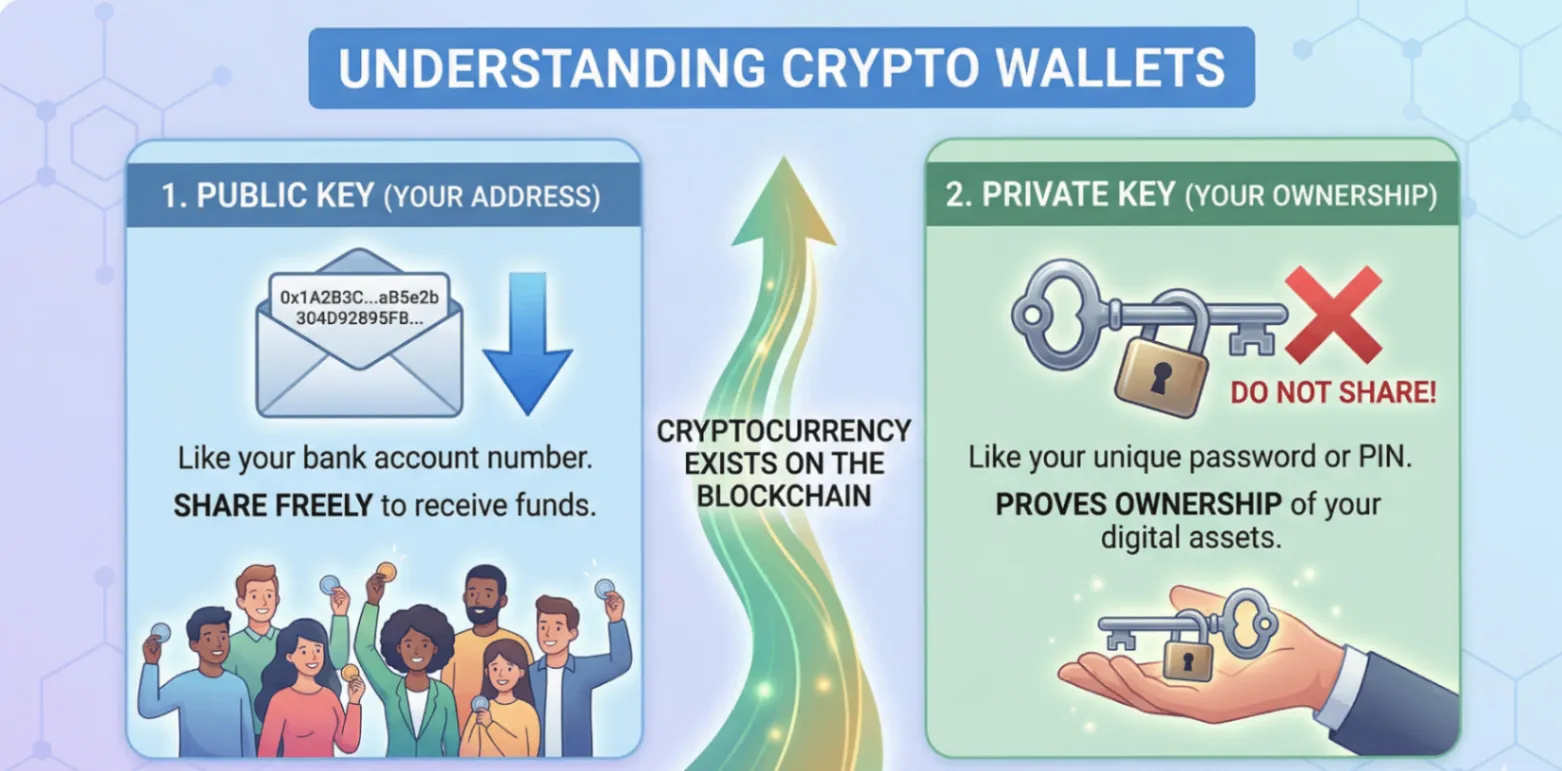
There are two types of keys involved in every crypto wallet. The first is your public key, which functions like a bank account number — you can share it freely with anyone who wants to send you cryptocurrency. The second is your private key, which functions like your PIN or password. It must never be shared with anyone, under any circumstances, because whoever holds the private key has complete control over the associated funds.
How Does a Crypto Wallet Work
When someone sends you cryptocurrency, they are essentially broadcasting a transaction to the blockchain that says a certain amount of digital assets is now associated with your public address. Your crypto wallet reads the blockchain and displays your balance by checking all transactions associated with your public key.
When you want to send cryptocurrency to someone else, your wallet uses your private key to digitally sign the transaction. This signature proves to the network that you are the rightful owner of those funds and that you have authorised the transfer. The signed transaction is then broadcast to the blockchain network, verified by nodes, and added to the permanent ledger.
This entire process happens in seconds or minutes depending on the network being used. The wallet software handles the technical complexity behind the scenes so that you can simply enter an address, specify an amount, and confirm the transaction.
The Role of a Seed Phrase
When you set up a crypto wallet, you will be given a seed phrase — typically a sequence of 12 or 24 randomly generated words. This seed phrase is the master key to your entire wallet. Every private key in your wallet can be derived from it.
It is absolutely critical that you write your seed phrase down on paper immediately and store it somewhere safe and offline. Never store it digitally, never photograph it, and never share it with anyone. If you lose access to your device and do not have your seed phrase, you will permanently lose access to your funds. There is no customer service team that can recover them for you.
Types of Crypto Wallets
Not all crypto wallets work the same way. There are two main categories to understand.
Custodial wallets are wallets where a third party — usually a centralised exchange — holds your private keys on your behalf. This means you are trusting that organisation to keep your assets safe. If the exchange is hacked, goes bankrupt, or freezes withdrawals, your funds are at risk.
Non-custodial wallets are wallets where you and only you hold your private keys. No third party has access to your funds. This is considered the gold standard of crypto security and is exactly how KIML Wallet is built. With a non-custodial wallet, you have complete, unconditional ownership of your digital assets at all times.
Why Your Choice of Wallet Matters
The crypto wallet you choose has a direct impact on the safety and accessibility of your assets. A well-designed wallet gives you full control, supports multiple cryptocurrencies across different blockchains, and makes it easy to send and receive funds without unnecessary complexity.
KIML Wallet is a non-custodial crypto wallet available for iOS, Android, and the web. It is built for both new and experienced users, with a clean interface, strong security standards, and a privacy-first design that ensures your assets remain entirely under your control. KIML Wallet is also fully open source — the complete codebase is publicly available on GitHub for anyone to inspect, audit, or contribute to.
Final Thoughts
A crypto wallet is your gateway to the world of digital assets. It stores the keys that prove your ownership, allows you to send and receive cryptocurrency, and keeps your funds accessible whenever you need them. Choosing a non-custodial wallet like KIML Wallet ensures that control of those keys remains exactly where it belongs — with you.
Download KIML Wallet:
- Android APK — kimlwallet.com
- iOS App — App Store
- Web Wallet — app.kimlwallet.com