
The phrase "crypto wallet" gets used constantly in conversations about cryptocurrency, but it is one of those terms that rarely gets a clear, plain-English explanation. If you have been nodding along whenever someone mentions it without really knowing what it means, this article is for you.
A crypto wallet explained simply is this: it is the tool you use to access, manage, and move your cryptocurrency. Everything else in crypto revolves around it.
The Simple Version First
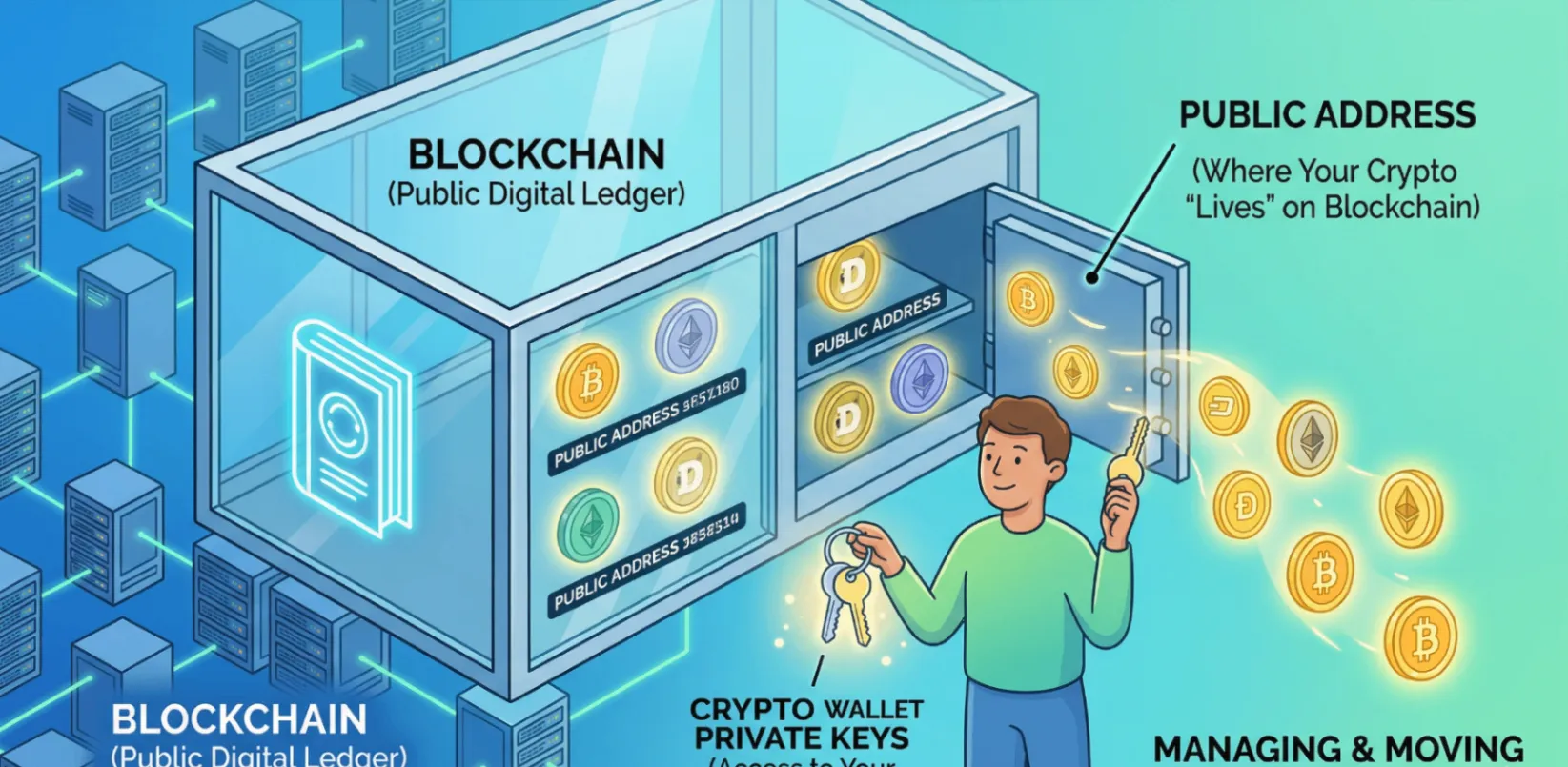
Imagine cryptocurrency as money that lives in a giant, transparent public vault that everyone in the world can see but only the right keyholder can access. Your crypto wallet is the keyring. It holds the specific keys that open your portion of that vault and let you move what is inside.
That is it at its most fundamental level. Your wallet holds your keys. Your keys give you access to your cryptocurrency on the blockchain. Without your keys, you cannot access your funds. With your keys, you have full and unconditional control.
What Is a Blockchain and Why Does It Matter
To truly understand a crypto wallet, it helps to understand what a blockchain is in simple terms.
A blockchain is a digital record book that is maintained by thousands of computers around the world simultaneously. Every transaction ever made with a particular cryptocurrency is recorded on that blockchain, permanently and publicly. No single person or company controls it — it simply exists, maintained collectively by the network.
When you own cryptocurrency, what you actually own is a record on that blockchain that says a certain amount of digital assets is associated with your address. Your crypto wallet is the software that reads that blockchain record and allows you to interact with it.
Public Keys and Private Keys Made Simple
Every crypto wallet works with two types of keys. Understanding these is the core of understanding how a crypto wallet works.
Your public key is like your home address. You give it to anyone who wants to send you something. It is completely safe to share. Knowing your public address does not give anyone access to your funds, just as knowing someone's home address does not let you into their house.
Your private key is like the key to your front door. It is what you use to prove you are the owner and to authorise transactions. If someone else gets hold of your private key, they can take everything in your wallet. It must never be shared, stored digitally, photographed, or given to anyone for any reason.
What a Seed Phrase Is
When you set up a crypto wallet, the application generates something called a seed phrase — a sequence of 12 to 24 randomly selected words that serves as the master backup for your entire wallet.
If you lose your phone, your private keys can be recovered using the seed phrase on any compatible device. This means your seed phrase is arguably even more important than your private key itself. Write it down by hand on paper. Store it securely offline. Never share it with anyone. Treat it like the most valuable document you own, because in crypto terms, it is.
Types of Crypto Wallets
Not all crypto wallets are built the same way. There are several different types, and each one comes with a different level of security and control.
- Hot wallets are crypto wallets that are connected to the internet. Mobile wallet apps and browser-based wallets fall into this category. They are convenient for everyday use and quick transactions, but being online means they carry a higher risk if security practices are not followed carefully.
- Cold wallets, also known as hardware wallets, are physical devices that store your private keys completely offline. They are considered the most secure option for storing large amounts of cryptocurrency long-term because they cannot be accessed remotely. The trade-off is that they cost money to purchase and are less convenient for frequent transactions.
- Custodial wallets are wallets where a third party — typically a centralised exchange — holds your private keys on your behalf. You access your funds through their platform but the keys themselves belong to the platform, not you. This means you are dependent on that company's security, solvency, and willingness to allow withdrawals.
- Non-custodial wallets are wallets where you hold your own private keys. No company has access to your funds. This is the approach taken by KIML Wallet, which operates on a fully non-custodial architecture to ensure users retain complete ownership of their digital assets at all times.
Why Non-Custodial Is the Right Choice
The history of cryptocurrency includes numerous cases of centralised exchanges being hacked, freezing withdrawals, or collapsing entirely. In every one of those cases, users who held their crypto on the exchange lost access to their funds. Users who held their crypto in non-custodial wallets were entirely unaffected because no third party had control over their keys.
Choosing a non-custodial wallet does come with personal responsibility. You must safeguard your seed phrase and private keys yourself. But this responsibility is a feature, not a bug. It is what genuine ownership of digital assets actually means.
How KIML Wallet Fits In
KIML Wallet is a non-custodial crypto wallet available on iOS, Android, and the web. It is built for users of every experience level, from complete beginners to experienced crypto participants. The interface is clean and intuitive, the security architecture is robust, and the wallet supports multiple cryptocurrencies across different blockchains from a single application.
With KIML Wallet, your private keys are generated on your device, stored locally, and never transmitted anywhere. The wallet never has access to your funds. You do, and only you. KIML Wallet is also fully open source — the complete codebase is available on GitHub for anyone to review or contribute to.
Final Thoughts
A crypto wallet explained simply is this: it is the tool that holds your keys, and your keys are what give you ownership and control over your cryptocurrency. The type of wallet you choose determines how much control you actually have. A non-custodial wallet like KIML Wallet gives you complete, unconditional ownership with no third party between you and your assets.
Download KIML Wallet:
- Android APK — kimlwallet.com
- iOS App — App Store
- Web Wallet — app.kimlwallet.com