
If you are new to crypto, one of the first questions you will hear is: do you have a wallet? Before you can buy, store, or send any cryptocurrency, you need to understand what a crypto wallet actually is — and how it works.
This guide breaks it all down in plain English. No jargon, no confusion. By the end, you will know exactly what a crypto wallet does, why you need one, and how to choose the right one for you.
What Is a Crypto Wallet?
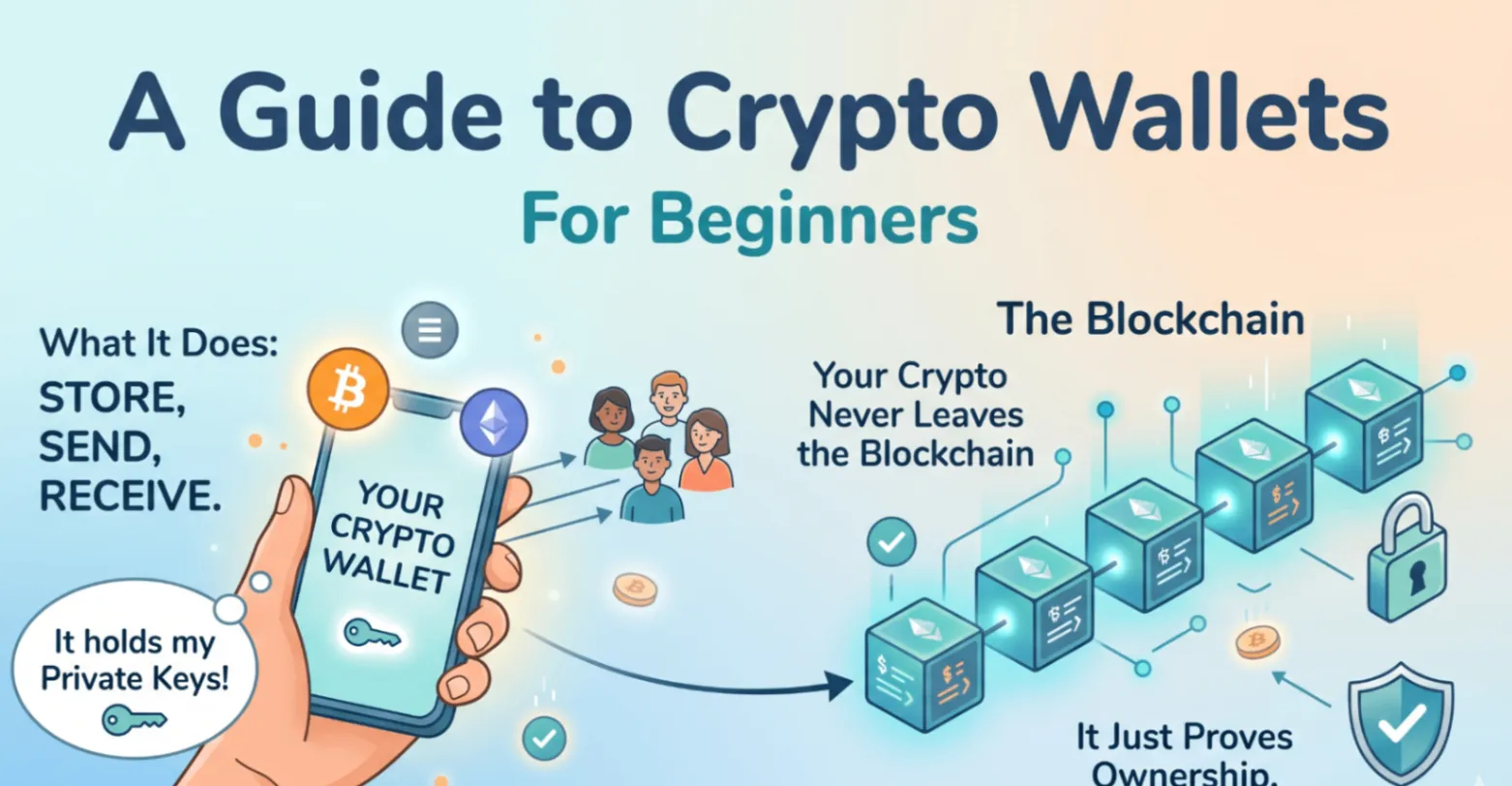
A crypto wallet is a tool that allows you to store, send, and receive cryptocurrency. Think of it like a digital bank account — but one that only you control.
Unlike a traditional bank account, a crypto wallet does not actually store your coins inside it. Instead, it stores your private keys — the secret codes that prove ownership of your crypto on the blockchain.
Key insight: Your crypto never leaves the blockchain. Your wallet simply holds the keys that give you access to it.
How Does a Crypto Wallet Work?
Every crypto wallet has two important pieces:
- Public Key (your wallet address): This is like your bank account number. You share it with others so they can send you crypto.
- Private Key: This is like your PIN or password. You never share this. It proves that you own the crypto in your wallet.
When someone sends you cryptocurrency, the transaction is recorded on the blockchain and linked to your public key. When you want to send crypto, your private key signs off on the transaction, confirming it is really you.
Types of Crypto Wallets
There are several types of crypto wallets, each with different levels of security and convenience:
- Hot Wallets: Connected to the internet. Easy to use for everyday transactions. Examples include mobile apps and browser wallets.
- Cold Wallets: Not connected to the internet. Much more secure for long-term storage. Examples include hardware wallets and paper wallets.
- Custodial Wallets: A third party (like an exchange) holds your private keys for you.
- Non-Custodial Wallets: You hold your own private keys. Full ownership, full control.
KIML Wallet is a non-custodial mobile wallet — meaning you own your keys and no one else can access your funds. It is also fully open source, so anyone can inspect the code on GitHub.
Why Do You Need a Crypto Wallet?
If you buy crypto on an exchange and leave it there, you do not truly own it. The exchange holds the keys — and if the exchange gets hacked or shuts down, your funds could be at risk.
A personal crypto wallet gives you:
- Full ownership of your cryptocurrency
- The ability to send and receive crypto directly
- Access to decentralised apps and DeFi protocols
- Security that you control, not a third party
Getting Started with KIML Wallet
KIML Wallet is designed for beginners and experienced users alike. It is free, non-custodial, and open source. Available for iOS, Android (APK), and the web — you can set it up in minutes with no technical knowledge required.
Download KIML Wallet:
- Android APK — kimlwallet.com
- iOS App — App Store
- Web Wallet — app.kimlwallet.com