

Not all crypto wallets are the same. Some keep your funds connected to the internet. Others lock them away offline. Some give you full ownership of your keys. Others hand that responsibility to a company.
Understanding the different types of crypto wallets is essential before you choose one. This guide breaks down every major category so you can pick the right wallet for your situation.
Hot Wallets vs Cold Wallets
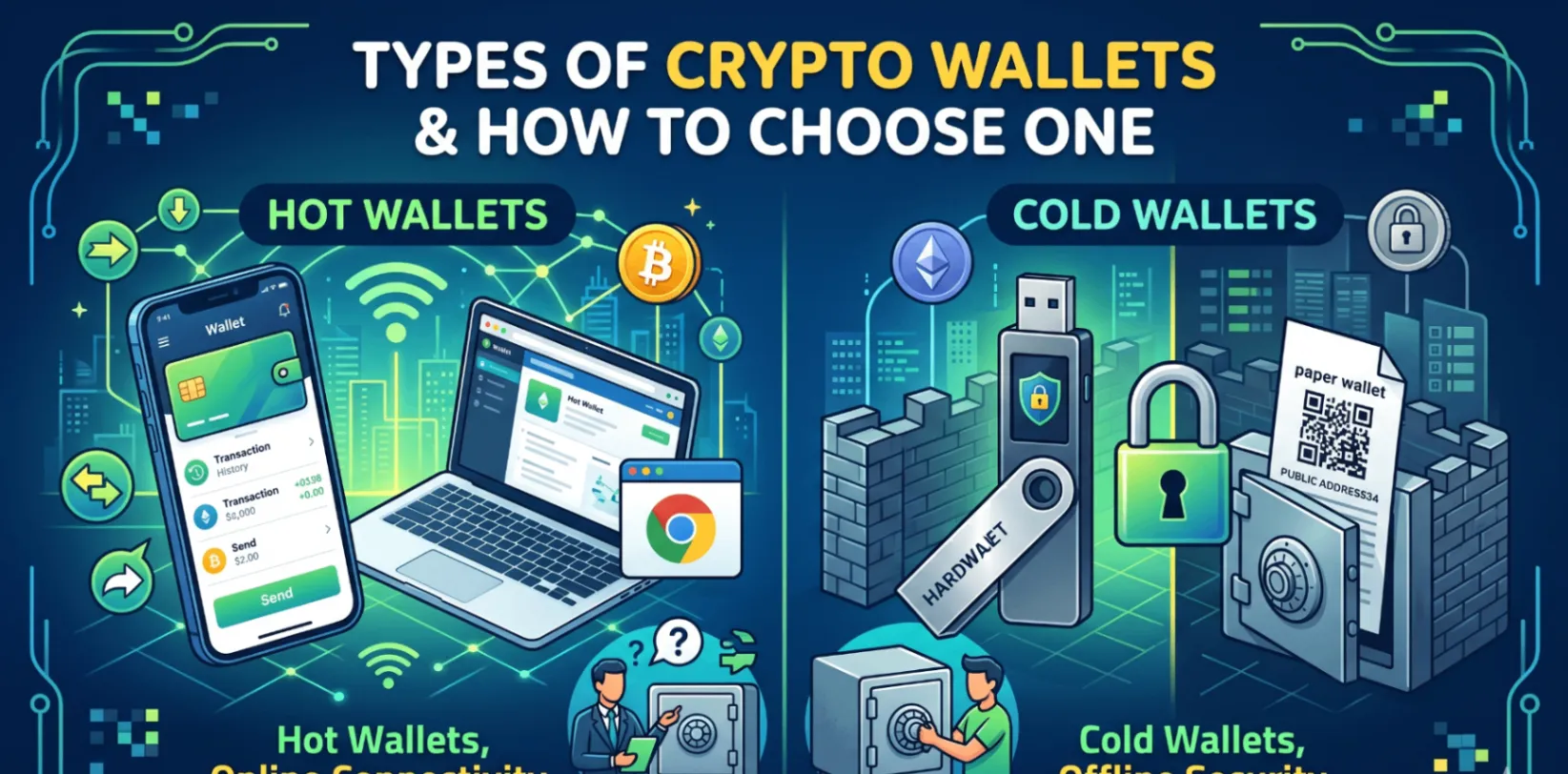
The most fundamental distinction in crypto wallets is whether they are connected to the internet.
- Hot Wallets: Always connected to the internet. Convenient for regular use. More exposure to online threats. Examples: mobile apps, desktop apps, browser extensions.
- Cold Wallets: Never connected to the internet. Much harder to hack. Best for large amounts. Examples: hardware wallets, paper wallets.
Most crypto users keep a small amount in a hot wallet for day-to-day use and larger amounts in cold storage for security.
Custodial vs Non-Custodial Wallets
This is the most important distinction for long-term crypto holders.
- Custodial Wallets: A company (like a crypto exchange) manages your private keys. You log in with an email and password. If the company is hacked or goes bankrupt, your funds are at risk.
- Non-Custodial Wallets: You hold your own private keys. No company can freeze or seize your funds. You are fully in control — but you are also fully responsible for keeping your seed phrase safe.
"Not your keys, not your coins." This phrase is the reason experienced crypto users almost always choose non-custodial wallets.
Mobile Wallets
Mobile wallets are apps you install on your smartphone. They are hot, non-custodial wallets designed for everyday use. Easy to set up, convenient to use, and typically support multiple cryptocurrencies.
KIML Wallet is a non-custodial mobile wallet available for iOS on the App Store and for Android as an APK download from kimlwallet.com. A web wallet is also available at app.kimlwallet.com. It supports multiple blockchains and coins in one simple app — and it is fully open source.
Hardware Wallets
Hardware wallets are physical USB-like devices that store your private keys offline. They are the gold standard for securing large amounts of crypto. They cost money upfront but provide maximum security. The trade-off is that they are less convenient for everyday transactions.
Browser Extension Wallets
These wallets live inside your browser as an extension (like MetaMask). They are designed for interacting with decentralised apps (dApps) and DeFi protocols. They are hot wallets, which makes them convenient but slightly more exposed to phishing attacks.
Which Type of Wallet Is Right for You?
- New to crypto: Start with a non-custodial mobile wallet like KIML Wallet.
- Holding large amounts long-term: Add a hardware wallet for cold storage.
- Using DeFi apps regularly: Consider a browser extension wallet alongside your mobile wallet.
- Just buying on an exchange: Move your funds to a personal non-custodial wallet as soon as possible.
KIML Wallet gives you all the features of a professional non-custodial wallet in a simple mobile app, with full open source transparency.
Get Started with KIML Wallet
Download KIML Wallet:
- Android APK — kimlwallet.com
- iOS App — App Store
- Web Wallet — app.kimlwallet.com